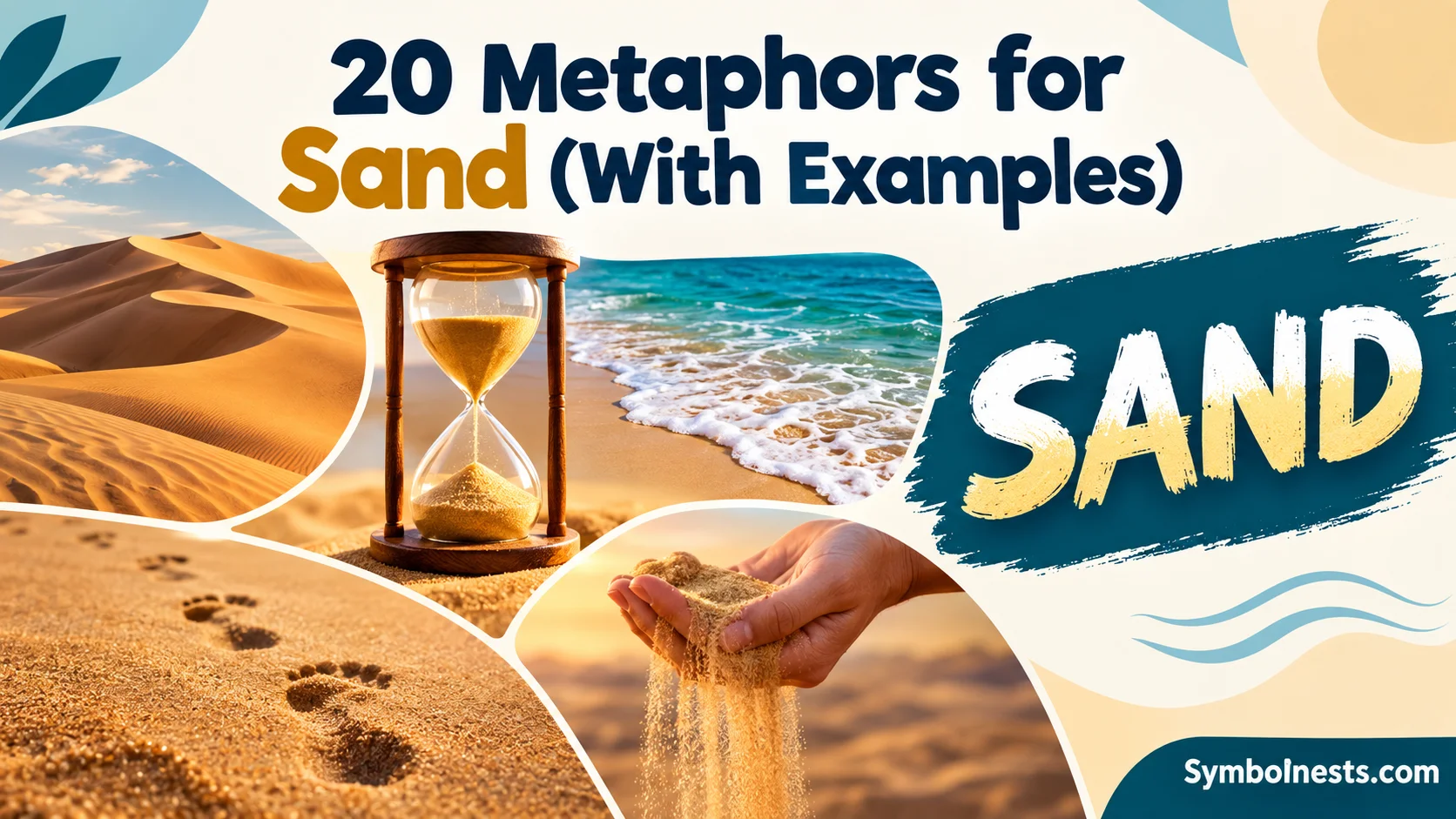
Metaphors for Sand can turn simple images of grains, beaches, and deserts into clear ideas about life, time, change, and human feelings. Sand may seem ordinary, but its movement, texture, and changing shape give writers many ways to create vivid imagery and meaningful comparisons. A single grain can represent a moment, while an hourglass can remind us that time keeps moving. From my experience with descriptive writing, these small details often make a story, poem, or speech feel more personal because readers can easily imagine the scene and connect it with their own experiences.
Sand can also represent fragility, freedom, resilience, and endurance. When grains slip through my fingers, they can suggest something difficult to keep, such as a memory, opportunity, or passing stage of life. A beach can represent peace, while a vast desert can suggest vastness, uncertainty, or countless possibilities. These comparisons help writers describe ordinary things in a fresh way and give familiar scenes greater depth and meaning. In poetry, storytelling, and descriptive writing, sand can therefore become a simple but powerful symbol of human experience.
Writers can also use sand through similes, comparing it with other things by using words such as like or as. Sand may be described as delicate, shifting, endless, or timeless, depending on the tone and purpose of the writing. A golden shimmer on a sunlit beach, endless dunes, or grains moving beneath the waves can create memorable imagery that helps readers see, feel, and imagine an idea. These creative comparisons can bring words to life, enrich expression, and add depth to language while connecting the natural world with human experiences.
1. Sand Is a Sea of Tiny Stars
Meaning
This metaphor means that sand sparkles and spreads across the ground like countless stars.
Detailed Explanation
When sunlight reflects on grains of sand, they can shine in small flashes. Comparing sand to a sea of tiny stars creates a magical and beautiful image. It works especially well when describing a beach, desert, or sunlit landscape. The metaphor focuses on the brightness and countless number of sand grains.
Example in a Sentence
As the sun rose, the beach became a sea of tiny stars, glittering beneath our feet.
3 Other Ways to Say It
- The shore was covered in little sparks.
- The beach glittered like a field of stars.
- Tiny crystals seemed to cover the ground.
2. Sand Is Nature’s Hourglass
Meaning
This metaphor means that sand represents the passing of time.
Detailed Explanation
Sand is closely connected with traditional hourglasses, where grains slowly fall from one side to another. Calling sand nature’s hourglass suggests that time moves steadily and cannot be stopped. A grain may seem small, but many grains falling together can measure minutes and hours. This metaphor can express the idea that every moment quietly passes away.
Example in a Sentence
Watching the grains slip through his fingers, he thought of sand as nature’s hourglass.
3 Other Ways to Say It
- Sand is a clock without numbers.
- Each grain carries a moment away.
- The beach keeps time in silence.
3. Sand Is a Golden Blanket
Meaning
This metaphor means that sand covers the ground like a warm blanket.
Detailed Explanation
A wide stretch of sand can appear soft and continuous from a distance. Calling it a golden blanket highlights its warm color and the way it spreads across the earth. The image can make a beach or desert feel peaceful and comforting. It also suggests that nature has gently covered the land.
Example in a Sentence
By noon, the desert looked like a golden blanket stretched beyond the horizon.
3 Other Ways to Say It
- The earth wore a golden cover.
- The dunes formed a warm carpet.
- A sheet of gold covered the ground.
4. Sand Is the Earth’s Powder
Meaning
This metaphor means that sand is a fine, loose covering made from broken pieces of rock and other natural materials.
Detailed Explanation
Powder consists of many tiny particles gathered together, much like sand. Describing sand as the Earth’s powder emphasizes its fine texture and natural origin. It can also create a close-up image of countless tiny pieces resting together. This metaphor works well when you want to focus on the physical texture of sand.
Example in a Sentence
The wind lifted the Earth’s powder and sent it swirling across the empty road.
3 Other Ways to Say It
- The ground was dusted with nature’s grains.
- Fine earth covered the surface.
- Tiny fragments formed a soft layer.
5. Sand Is a River of Time
Meaning
This metaphor means that sand represents time constantly moving forward.
Detailed Explanation
A river keeps flowing, and time keeps moving in much the same way. Sand can also flow through an hourglass, between fingers, or down the side of a dune. Calling it a river of time combines movement with the idea of passing moments. The metaphor reminds us that life continues even when we wish a moment could stay.
Example in a Sentence
The sand flowing through the old glass seemed like a river of time carrying the years away.
3 Other Ways to Say It
- Time flowed through the grains.
- The moments slipped away like sand.
- Each grain joined the current of time.
6. Sand Is a Desert’s Ocean
Meaning
This metaphor means that a vast desert can look like a huge ocean made of sand.
Detailed Explanation
Large sand dunes rise and fall like ocean waves. When viewed from far away, the desert may appear endless, much like the sea. Calling sand a desert’s ocean creates a powerful image of movement, size, and beauty. Unlike water, however, these waves remain dry and shaped by the wind.
Example in a Sentence
From the hilltop, the dunes rolled below us like a desert’s ocean.
3 Other Ways to Say It
- The dunes were frozen waves.
- A dry sea stretched ahead.
- The desert rolled like the ocean.
7. Sand Is a Book of Footprints
Meaning
This metaphor means that sand records where people and animals have traveled.
Detailed Explanation
Fresh sand can hold footprints, tracks, and marks for a short time. These signs can tell a small story about who passed through and where they went. Calling sand a book of footprints suggests that the ground can briefly preserve stories. Wind and water may later erase the marks, which also adds the idea that some stories do not last forever.
Example in a Sentence
The quiet beach became a book of footprints after the early morning walkers passed by.
3 Other Ways to Say It
- The shore recorded every step.
- The ground told stories through tracks.
- Footprints wrote across the beach.
8. Sand Is a Memory That Slips Away
Meaning
This metaphor means that some memories fade or disappear no matter how hard we try to hold them.
Detailed Explanation
Sand easily slips through open fingers. Memories can feel the same way when details slowly become less clear over time. Comparing sand to a memory that slips away creates a thoughtful image of loss and change. It reminds us that even meaningful experiences can become harder to remember.
Example in a Sentence
Her childhood summers felt like a memory that slips away, clear for a moment and then gone.
3 Other Ways to Say It
- The memory faded like scattered grains.
- The past slipped quietly away.
- The moment could not be held.
9. Sand Is a Million Little Secrets
Meaning
This metaphor means that sand can hide countless stories, objects, and mysteries.
Detailed Explanation
Beaches and deserts have existed for long periods of time. Beneath the surface, sand may cover shells, objects, tracks, or signs of earlier life. Calling it a million little secrets gives sand a mysterious quality. It suggests that every grain may be part of a much larger story we cannot fully see.
Example in a Sentence
Beneath the quiet shore lay a million little secrets waiting for the tide to reveal them.
3 Other Ways to Say It
- The beach hid countless mysteries.
- The grains kept old stories buried.
- The ground held secrets beneath its surface.
10. Sand Is a Sculptor’s Clay
Meaning
This metaphor means that sand can be shaped and molded into many forms.
Detailed Explanation
Wet sand is easy to press, shape, and build with. People use it to make castles, animals, walls, and creative designs. Comparing sand to a sculptor’s clay highlights its flexibility and creative potential. The metaphor also reminds us that beautiful things can come from very simple materials.
Example in a Sentence
With a bucket and a shovel, the children turned the shore into a sculptor’s clay.
3 Other Ways to Say It
- The beach became a creative canvas.
- Wet sand waited to be shaped.
- The shore was a builder’s material.
11. Sand Is a Whispering Crowd
Meaning
This metaphor means that many tiny grains can create a soft, collective sound.
Detailed Explanation
Wind, footsteps, and moving sand can create gentle rustling noises. One grain makes almost no sound, but together millions of grains can produce a quiet movement. Calling sand a whispering crowd gives it a human-like feeling. The metaphor focuses on the way many small things can create one larger experience.
Example in a Sentence
As the wind crossed the dune, the sand became a whispering crowd beneath the moonlight.
3 Other Ways to Say It
- The grains murmured in the wind.
- The shore seemed to speak softly.
- A quiet chorus moved across the dunes.
12. Sand Is a Fragile Foundation
Meaning
This metaphor means that something may look stable but cannot provide strong support.
Detailed Explanation
Loose sand shifts easily under pressure. For that reason, building something heavy on unstable sand can be risky. In everyday language, a fragile foundation can describe a weak plan, relationship, argument, or system. The metaphor warns that something important needs strong support to last.
Example in a Sentence
Their agreement was built on a fragile foundation because neither side trusted the other.
3 Other Ways to Say It
- The plan rested on weak ground.
- The idea had an unstable base.
- The support could easily collapse.
13. Sand Is a Moving Canvas
Meaning
This metaphor means that sand constantly changes shape and appearance.
Detailed Explanation
Wind can draw lines across sand, while waves can erase and replace patterns along the shore. Each moment may create a different design. Calling sand a moving canvas highlights this endless process of change. It suggests that nature is always creating and removing artwork.
Example in a Sentence
At sunrise, the untouched beach looked like a moving canvas painted by the wind.
3 Other Ways to Say It
- Nature kept redrawing the shore.
- The wind painted new patterns.
- The beach changed like living artwork.
14. Sand Is a Treasure Chest of Time
Meaning
This metaphor means that sand can preserve pieces of the past.
Detailed Explanation
Sand can cover shells, fossils, and objects from earlier times. Over long periods, layers of sand may protect things beneath the surface. Calling sand a treasure chest of time suggests that history can remain hidden inside the earth. It creates a sense of discovery and reminds us that the past often waits quietly beneath us.
Example in a Sentence
The archaeologist treated the ancient shoreline as a treasure chest of time.
3 Other Ways to Say It
- The ground stored pieces of history.
- The sand guarded the past.
- Hidden treasures rested beneath the grains.
15. Sand Is a Cloud on the Ground
Meaning
This metaphor means that blowing or drifting sand can resemble a cloud.
Detailed Explanation
Strong wind can lift fine sand into the air, creating soft and shifting shapes. Even still sand can appear smooth and light across the ground. Calling it a cloud on the ground connects the softness of the sky with the texture of the earth. The metaphor creates a gentle and unusual visual image.
Example in a Sentence
The pale dune looked like a cloud on the ground beneath the bright afternoon sky.
3 Other Ways to Say It
- The earth wore a fallen cloud.
- A soft haze covered the ground.
- The dune looked like sky turned solid.
16. Sand Is a Crowd of Tiny Travelers
Meaning
This metaphor means that sand grains can move from place to place through wind and water.
Detailed Explanation
A single grain of sand may travel across a beach, down a river, or through the wind. Over time, millions of grains move and settle in new places. Calling sand a crowd of tiny travelers gives each grain a sense of movement and adventure. It reminds us that landscapes are never completely still.
Example in a Sentence
During the storm, the beach became a crowd of tiny travelers racing before the wind.
3 Other Ways to Say It
- The grains journeyed with the wind.
- Tiny particles traveled across the land.
- The sand wandered from place to place.
17. Sand Is an Endless Puzzle
Meaning
This metaphor means that sand contains countless small pieces that are difficult to count or understand completely.
Detailed Explanation
Every grain has its own size, shape, and history. Together, they form beaches, dunes, and deserts that constantly change. Calling sand an endless puzzle emphasizes its complexity. The more closely we look, the more details we discover.
Example in a Sentence
The scientist studied the shoreline as an endless puzzle made from countless tiny pieces.
3 Other Ways to Say It
- Every grain was part of a larger mystery.
- The beach was a puzzle without an end.
- Nature arranged countless tiny pieces together.
18. Sand Is a Silent Messenger
Meaning
This metaphor means that sand can carry signs and information without using words.
Detailed Explanation
Sand can show where the wind has blown, where waves have reached, and where people or animals have walked. These marks can communicate information to anyone who knows how to notice them. Calling sand a silent messenger highlights its ability to tell stories without speaking. The message may be temporary, but it can still be meaningful.
Example in a Sentence
The tracks in the sand acted as a silent messenger, showing that someone had arrived before us.
3 Other Ways to Say It
- The ground spoke without words.
- The grains carried quiet messages.
- The shore revealed a hidden story.
19. Sand Is a Kingdom of Small Things
Meaning
This metaphor means that something vast can be made from countless tiny pieces.
Detailed Explanation
A desert or beach can seem enormous, yet it is built from tiny grains. Calling sand a kingdom of small things creates a contrast between size and smallness. It reminds us that many small parts can join together to create something impressive. This metaphor can also express the power of small contributions.
Example in a Sentence
The wide beach was a kingdom of small things, built one tiny grain at a time.
3 Other Ways to Say It
- Greatness grew from tiny pieces.
- Countless small grains created something vast.
- Little parts formed a grand landscape.
20. Sand Is a Lesson in Letting Go
Meaning
This metaphor means that some things cannot be controlled or held forever.
Detailed Explanation
The tighter we try to hold dry sand, the more easily it can escape through our fingers. This makes sand a powerful image for situations that require patience and acceptance. Calling it a lesson in letting go suggests that holding on too tightly can sometimes make loss feel worse. The metaphor encourages us to accept that change is a natural part of life.
Example in a Sentence
As the grains slipped through her hand, sand became a lesson in letting go.
3 Other Ways to Say It
- Some things are meant to pass.
- Not everything can be held forever.
- Letting go can be part of moving forward.
Exercise to Practice
1. Which metaphor mainly represents the passing of time?
A. Sand is a golden blanket.
B. Sand is nature’s hourglass.
C. Sand is a whispering crowd.
D. Sand is a moving canvas.
2. Which metaphor best describes a desert that looks like the sea?
A. Sand is a desert’s ocean.
B. Sand is a fragile foundation.
C. Sand is a silent messenger.
D. Sand is a cloud on the ground.
3. What does “sand is a book of footprints” suggest?
A. Sand is difficult to read.
B. Sand can briefly record movement and stories.
C. Sand is made from paper.
D. Sand never changes.
4. Which metaphor would best describe an unstable plan?
A. Sand is a kingdom of small things.
B. Sand is a sea of tiny stars.
C. Sand is a fragile foundation.
D. Sand is a treasure chest of time.
5. What idea does “sand is a memory that slips away” express?
A. Memories can fade over time.
B. Sand improves memory.
C. Memories are always accurate.
D. Sand never moves.
6. Which sentence uses the idea of sand as a “moving canvas” correctly?
A. The wind created new patterns across the beach.
B. The sand made the clock stop.
C. The beach became stronger than stone.
D. The grains stayed in exactly the same place.
7. Which metaphor focuses on hidden history beneath the ground?
A. Sand is a whispering crowd.
B. Sand is a treasure chest of time.
C. Sand is a golden blanket.
D. Sand is a cloud on the ground.
8. What does “sand is a crowd of tiny travelers” emphasize?
A. Sand grains can move from place to place.
B. Sand is always completely still.
C. Sand is made by people.
D. Sand can speak loudly.
9. Which metaphor best highlights the creative use of wet sand?
A. Sand is a sculptor’s clay.
B. Sand is a river of time.
C. Sand is a silent messenger.
D. Sand is an endless puzzle.
10. What does the metaphor “sand is a million little secrets” suggest?
A. Sand contains hidden stories and mysteries.
B. Sand knows how to speak.
C. Sand is always dangerous.
D. Sand is easy to count.
11. Which metaphor focuses most strongly on many small parts creating something large?
A. Sand is a kingdom of small things.
B. Sand is a cloud on the ground.
C. Sand is a memory that slips away.
D. Sand is nature’s hourglass.
12. What does “sand is a silent messenger” mean in context?
A. Sand can show signs and tell stories without words.
B. Sand sends written letters.
C. Sand is louder than the ocean.
D. Sand cannot reveal anything.
13. Which metaphor would best fit sparkling beach sand at sunrise?
A. Sand is a fragile foundation.
B. Sand is a sea of tiny stars.
C. Sand is a lesson in letting go.
D. Sand is an endless puzzle.
14. Which idea is most closely connected to “sand is a lesson in letting go”?
A. Trying to control everything.
B. Accepting change and release.
C. Building stronger walls.
D. Counting every grain.
15. Which statement best explains why metaphors are useful when describing sand?
A. They make every description scientifically exact.
B. They create vivid images and deeper meanings.
C. They remove all emotion from writing.
D. They make simple ideas harder to understand.
Answers
- B — Sand is nature’s hourglass.
- A — Sand is a desert’s ocean.
- B — Sand can briefly record movement and stories.
- C — Sand is a fragile foundation.
- A — Memories can fade over time.
- A — The wind created new patterns across the beach.
- B — Sand is a treasure chest of time.
- A — Sand grains can move from place to place.
- A — Sand is a sculptor’s clay.
- A — Sand contains hidden stories and mysteries.
- A — Sand is a kingdom of small things.
- A — Sand can show signs and tell stories without words.
- B — Sand is a sea of tiny stars.
- B — Accepting change and release.
- B — They create vivid images and deeper meanings.
Conclusion
Metaphors for Sand show how ordinary grains can represent time, change, fragility, freedom, and human experience. By using sand in metaphors and similes, writers can create vivid imagery, express deeper feelings, and make their writing more memorable. Whether used in poetry, storytelling, or descriptive writing, sand offers endless ways to turn simple ideas into meaningful words.
Read More:20 Metaphors for School (With Examples)
Frequently Asked Questions
Q1. What is a metaphor for sand?
A metaphor for sand compares sand to something else without using “like” or “as.” For example, calling sand nature’s hourglass connects it with the passing of time. The comparison creates a deeper meaning beyond a simple physical description.
Q2. How is a metaphor for sand used?
A metaphor for sand can be used in stories, poems, essays, speeches, and everyday conversations. It can describe the appearance, movement, meaning, or emotional effect of sand. The best metaphor depends on the idea you want to communicate.
Q3. Why do writers use metaphors for sand?
Writers use these metaphors to create stronger images and emotions. Sand can represent many ideas, including time, change, memory, and mystery. A good metaphor helps readers understand those ideas in a more memorable way.
Q4. What is an easy example of a metaphor for sand?
An easy example is “Sand is nature’s hourglass.” This metaphor suggests that sand represents time moving steadily forward. It creates a simple but meaningful image.
5. How can I use metaphors for sand in my own writing?
Start by thinking about what sand reminds you of, such as time, stars, waves, memories, or change. Then connect that idea to the feeling you want your reader to experience. Keep your comparison natural and use it where it adds meaning to your writing.